Nov 6, 2026 | In Blog
Kente as Intellectual Property:
Is Ghana's Dual Protection Framework Fit for Purpose?
Who Owns Kente's Copyright?
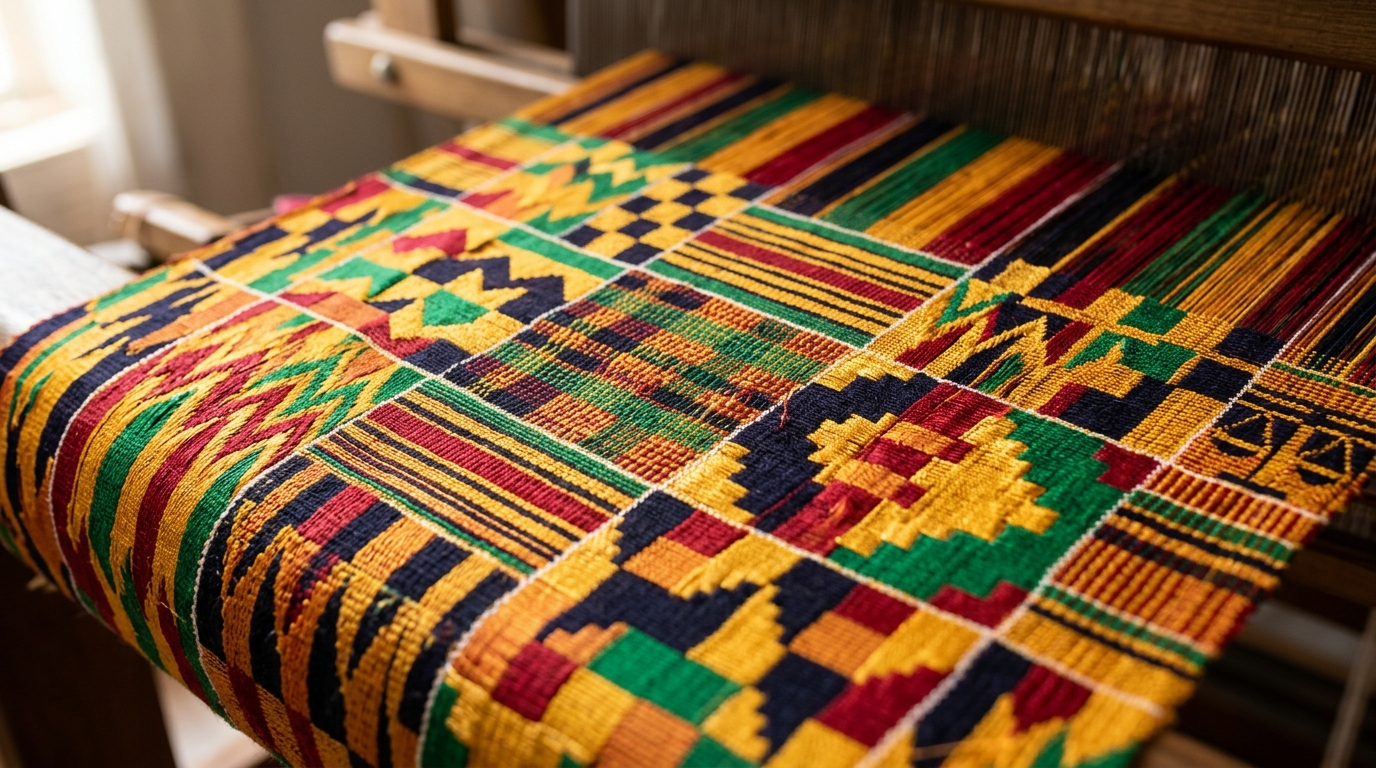
When you graduate, you wear Kente. When you get married, you wear Kente. It’s Friday at work, and Kente might be your choice again. From celebrating personal milestones to representing Ghana on the world stage, Kente is a familiar part of how Ghanaians express their identity and heritage. Its colours, patterns and cultural significance have made it one of the country’s most recognisable symbols.
We see it so often, and we love it so much. But how often do we stop to think about how it is protected? We know what Kente represents, but do we know who owns its copyright, or what the law says about protecting it?
The questions become even more interesting when we discover that Kente is protected as a geographical indication as well as under copyright law. Why does it need both? And when the law provides that rights in certain traditional cultural expressions vest in the President on behalf of the people of Ghana, does that mean the state owns Kente? What exactly does that ownership cover? Is a second layer of protection necessary, or does it serve a different purpose?
Why Does Copyright Protect Kente?
Kente is more than a recognisable Ghanaian cloth. Under Ghanaian law, some of its traditional designs are also protected as folklore. That raises an interesting question: how can a design that belongs to a cultural tradition be protected by copyright, especially when its original creator may no longer be known?
Section 76 of the Copyright Act, 2005 (Act 690), provides part of the answer. It defines folklore to include creative expressions that form part of Ghana’s cultural heritage and have been created, preserved and developed by Ghanaian ethnic communities or by an unidentified Ghanaian author. The definition specifically includes Kente and Adinkra designs whose authors are unknown. In other words, a design does not have to be traced to a named individual to fall within the law’s protection of folklore.
But what does that protection actually mean? Section 4 of the Act protects expressions of folklore against specified uses, including reproduction, communication to the public and adaptation or other transformation. This gives the law a way to protect these cultural expressions against certain forms of use. Exactly what is permitted, and when authorisation is required, depends on the Act’s other provisions.
There is another twist. If these designs form part of Ghana’s cultural heritage, who holds the rights to them?
Under section 4(2), the rights in folklore are vested in the President on behalf of, and in trust for, the people of Ghana. That might sound as though Kente belongs to whoever occupies the presidency, but it does not. The President holds those rights in a representative capacity for the Ghanaian people. And unlike ordinary copyright, which generally lasts for a limited period, the rights in folklore exist in perpetuity under section 17. They do not expire after a fixed term.
However, not every Kente design is necessarily protected in the same way. Consider the difference between a traditional design whose author is unknown and a new design created by an individual weaver. The first may fall within the Act’s definition of folklore. The second may qualify for ordinary copyright protection as an artistic work, provided it meets the relevant legal requirements.
Section 1 requires a work to be original and fixed in a form that can be perceived or reproduced, alongside the applicable nationality, publication or treaty requirements. Section 76 also includes works of applied art—whether handmade or produced industrially—within its definition of artistic work. So, a newly created Kente design may qualify for copyright protection, but that depends on the particular design and whether it meets the statutory requirements. Being Kente, by itself, does not settle the question.
Copyright also has its limits. Section 2 makes clear that it does not protect ideas, concepts or methods as such. The general idea of weaving Kente, for example, is not automatically owned by someone simply because a particular design can be protected.
The distinction is important: Ghanaian law can protect certain traditional Kente designs as folklore while also protecting new, original designs through ordinary copyright. But those protections do not automatically apply to every cloth or pattern in the same way.
What Does Geographical Indication Protection Add?
Imagine two situations.
In the first, someone copies a distinctive Kente pattern and reproduces it without permission. In the second, a seller markets cloth as Kente even though it does not meet the requirements associated with the recognised weaving tradition. Both situations raise questions about protecting Kente, but they are not the same problem.
Copyright can protect a qualifying design. A geographical indication (GI) protects something different: the link between a product and the place whose reputation, traditions or characteristics give it its identity.
Think about what the name Kente communicates. It is not simply a description of a particular arrangement of colours and patterns. It also carries associations with Ghana, its weaving communities and the skills passed down through generations. If the name is used on products that do not meet the requirements for that geographical identity, the reputation of the people who produce authentic Kente may suffer.
That is the idea behind GI protection. Under section 22 of Ghana’s Geographical Indications Act, 2003 (Act 659), a geographical indication identifies goods whose quality, reputation or other characteristic is essentially linked to their geographical origin. The Act expressly includes Kente among the goods that can be protected.
Ghana registered Kente as its first geographical indication in 2025. The registration marked an important step towards protecting the name and its connection to the recognised places of production. But registration is not simply a stamp of national pride. It has practical consequences for who can use the protected indication in business.
Under section 11 of Act 659, the right to use a registered GI in trade is limited to producers carrying on the relevant activity in the geographical area specified in the Register, provided their products meet the requirements set for the indication. Sections 1 and 5 also provide remedies against certain misleading uses and unfair competition.
Neither gives one person ownership of every Kente design. And a GI does not automatically protect every pattern from being copied. The point is that protecting a design and protecting the name and reputation associated with a place are not interchangeable tasks.
Kente’s protection therefore involves more than deciding who can copy a pattern. It also involves protecting the identity that generations of Ghanaian weavers have built around the cloth.
Two Layers of Protection - or Unnecessary Overlap?
Copyright can protect particular designs, but Kente’s identity and reputation extend beyond any single pattern. They have been shaped collectively by weaving communities over generations. Before Ghana registered Kente as a geographical indication in 2025, the limitations of copyright were already prompting calls for GI protection to address some of its gaps.
But even with both forms of protection in place, a bigger question remains: who actually benefits?
Under Ghana’s Copyright Act, rights in folklore are vested in the President on behalf of, and in trust for, the Ghanaian people. GI protection, by contrast, is tied to qualifying producers within the registered geographical area. One arrangement speaks to cultural heritage held on behalf of the nation; the other regulates who can use a protected indication in trade. Neither arrangement, by itself, guarantees that individual weavers will receive a fair share of the commercial benefits or have a meaningful say in how their heritage is represented.
The international reach of Kente raises a further challenge. Although Ghana has registered Kente as a geographical indication, that registration does not automatically provide equivalent protection in every foreign market. Kente may be recognised around the world as a symbol of Ghanaian heritage, but the legal options available to challenge misuse of the protected name will depend on the protection available in the country concerned.
Does Ghana Need Both?
So, who owns Kente’s copyright? There is no single answer for every Kente design. The law treats traditional expressions of folklore differently from newly created designs, and copyright alone does not determine who can use the name Kente in trade.
That is why Ghana has a strong case for retaining both copyright and geographical indication protection. They address different aspects of what makes Kente valuable: its creative designs and its identity as a product rooted in Ghanaian weaving traditions. Neither system can do the work of the other. Whether the two together deliver effective protection, however, depends on how they are implemented and whose interests they serve.
But legal recognition is only part of the picture. For this framework to be effective, its protections must be meaningfully enforced, and the interests of the weaving communities whose knowledge and skill sustain Kente must remain central. The available evidence establishes why additional protection was needed; it is too early to conclude, on that basis alone, how fully the 2025 registration has delivered on that promise.
Kente is more than a cloth, and protecting it is about more than deciding who can copy a pattern. It is also about safeguarding the connection between the cloth, the people who make it and the cultural heritage they carry forward. Ghana’s dual protection framework provides a basis for doing that. Its real test is whether that protection can serve the tradition and the communities behind it.
This article is for general information only and does not constitute legal advice. For advice regarding a specific legal matter, please contact Corporate and Allied Attorneys.
Source List
- Copyright Act, 2005 (Act 690) - sections 1, 2, 4, 17, 19, 64 and 76.
https://repository.parliament.gh/server/api/core/bitstreams/4b7ed217-30e6-49bd-80ad-21e081c357cc/content - Geographical Indications Act, 2003 (Act 659) - sections 1, 2, 5-7, 10-13 and 22.
https://repository.parliament.gh/server/api/core/bitstreams/32af7b2f-253a-432d-8008-54e30078e725/content - Michelle Okyere and Janice Denoncourt, “Protecting Ghana’s intellectual property rights in kente textiles: the case for Geographical Indications” (2021)
https://academic.oup.com/jiplp/article/16/4-5/415/6133909 - Registrar-General’s Department, “Geographical Indications”
https://rgd.gov.gh/gi.html - UNESCO, “Craftsmanship of Traditional Woven Textile Kente” (2024)
https://ich.unesco.org/en/RL/craftsmanship-of-traditional-woven-textile-kente-02130?utm_ - Chidi Oguamanam and Angela Yeboah-Appiah, “Kente Weaving Among Akan and Ewe Peoples of Ghana” (2024)
https://www.cambridge.org/core/journals/international-journal-of-cultural-property/article/kente-weaving-among-akan-and-ewe-peoples-of-ghana-a-genderbased-insight-into-embedded-intangible-cultural-heritage-and-implications-for-the-implementation-of-the-unesco-intangible-cultural-heritage-convention/657EC231EDB91E137E01C9886D5A857E